Jourdan Bell1, Emi Kimura1, Bill Pinchack2, Jason Smith3, Bridget Guerrero4, Will Keeling5, and Paul DeLaune6
1Extension Agronomist-Texas A&M AgriLife (TAMU) Extension Service, 2Animal Nutritionist – TAMU Research,
3Beef Cattle Specialist – TAMU Extension, 4Professor of Ag Business and Economics – West Texas A&M University,
5Risk Management specialist (TAMU Extension), and 6Chair of Crop, Soil and Environmental Sciences, University
of Arkansas
WHAT IS COVER CROP?
Cover crops are broadly defined as plants that “cover” the soil, which are generally grown for purposes other than growing a crop to be harvested and sold. Cover crops are known to improve soil chemical, physical, and biological properties and thus improve nutrient cycling, soil structure, and infiltration. Grazing a cover crop benefits soil health by increasing the rate of nutrient cycling and providing an economic return during the cover crop period, but there should be sufficient biomass to economically support the livestock while also providing the soil health benefits. Increasing soil organic matter and soil organic carbon (Please refer to the “Factors affecting carbon sequestration potential in a semi-arid environment” for more about the soil carbon.) are often primary objectives for many producers, but this is dependent on the quantity of biomass produced and retained in each system. Biomass production and ultimately soil organic matter and soil organic carbon are limited by water, soils (type and fertility), temperature, and the duration of the growing season (Ontl and Schulte, 2012).
CONSIDERATIONS BEFORE GROWING A COVER CROP
Different cover crop species are often selected for the different soil health benefits that they may provide. While most species may provide both soil health benefits and a supplemental, highly nutritious forage source for grazing, some marketed cover crop species may not be adapted to the SGP. When selecting a cover crop, producers should consider the water requirement, biomass production potential, nutritive value, and whether there are any toxicity concerns before picking a cover crop for grazing.
Biomass Production
In water-limited systems, biomass production is reduced during periods of extended drought. As a result, produced biomass may not coincide with the grazing period, or there may not be sufficient biomass for an extended grazing window resulting in premature livestock removal. The stocking rate (number of animal units per acre) should match the desired rate of gain and grazing duration (refer to AgriLife publication How to Determine Stocking Rates). If livestock are prematurely removed, producers may encumber freight costs that negate the financial return associated with any yield gain if livestock are prematurely removed because of insufficient biomass and reduced weight gain.
Toxicity of certain cover crop species
While hairy vetch is incorporated into cover crop mixes because it is a legume with strong root activity, it should be avoided if grazing livestock because of hairy vetch toxicosis (vetch poisoning), which can be fatal for some classes of livestock (refer AgriLife publication Quick Guide for Livestock Toxicities in Cover Crop Species). Nitrates can also accumulate in water-stressed cover crops, including small grains, so producers should be aware of current and previous fertility programs when turning out livestock on stressed forages. Prussic acid (hydrogen cyanide) can be a concern in sorghum species under stressed conditions. If there is any concern, the forage should be tested for toxins before releasing livestock. Please refer to the publications “Testing Forages and Hay for Hydrogen Cyanide (Prussic Acid) Potential” and “Nitrates and Prussic Acid in Forages” for more about these topics.
Hidden economic benefits from the improvement of soil health
If sufficient biomass is produced to meet the livestock requirements, grazing cover crops can provide producers with a cost-effective forage, improved soil health, and potentially increased revenue. The estimated hidden economic benefits of reducing soil erosion with the use of cover crops were estimated to be $4/ac/yr to $39/ac/yr, depending on species and duration of impact (Fan et al., 2020) (refer AgriLife publication Economics of Grazing Cover Crops).
Winter cover crops
On the Southern Great Plains (SGP), cover crops are primarily planted in fall or early winter following harvest of the summer crop. Cover crop establishment is dependent on timely fall and/or winter precipitation or irrigation. If the cover is planted late, it does not often become established until late winter or early spring, which does not provide any biomass for winter grazing. Spring growth is important for reducing erosion from spring windstorms as well as providing summer residue to minimize evaporative losses from the soil. Annual small grains (wheat, rye, triticale, barley, and oats) are well adapted for grazing as well as SGP cropping systems, but forage potential is dependent on the planning date and water availability (irrigation and/or precipitation). Legumes such as winter peas, hairy vetch, and clover are often incorporated into winter cover crop mixes for nitrogen fixation, but legumes can also add a highly digestible, high-protein forage source to the mix.
Summer cover crops
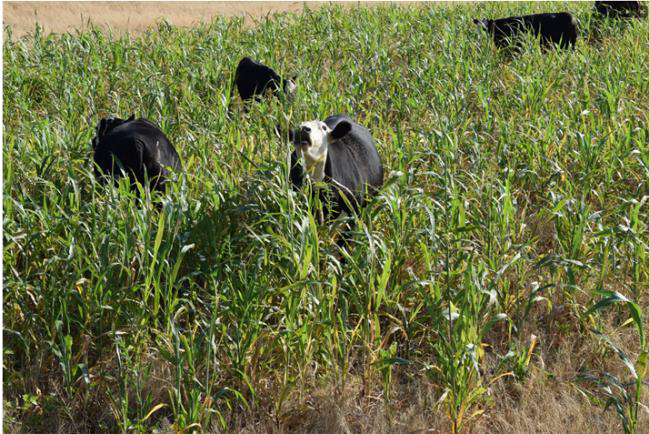
While winter cover crops are the most common in rotation with low-residue summer crops such as cotton, summer cover crops may also provide producers with grazing opportunities and soil health benefits. On the SGP, summer cover crops may include blends of sorghum-sudan, millet, cowpeas, okra, sunflowers, and other drought-tolerant, warm-season annuals or monoculture sorghum-sudan, millet, or cowpeas, which depending on growing season conditions, may provide producers with beneficial summer and fall forage.
Nutrient cycle and livestock activities
Producers who incorporate grazing to improve soil health benefits (nutrient cycling and hoof activity) should carefully consider crop and livestock production windows before planning to incorporate livestock. Livestock hoof activity accelerates both the physical and chemical breakdown of plant material, which accelerates soil organic matter and organic carbon accretion. Partial incorporation of plant material into the soil surface through livestock hoof action further accelerates the nutrient cycling process. Since ruminants have relatively low nitrogen use efficiency, a large portion of the nitrogen consumed in the form of protein is recycled to the soil. Other nutrients, such as phosphorus, that are consumed in excess of the livestock’s requirements are excreted by the animal and returned to the soil. Such nutrients are returned to the local nutrient cycle by the animal rather than being removed from the local cycle and transported elsewhere. Nutrient supplementation of cattle grazing cover crops indirectly adds nutrients to the system, which may help fuel microbial activity, support cover crop growth, and promote soil health.
Soil compaction
Under wet conditions, hoof activity can cause compaction, so it is important to consider the soil moisture when turning livestock out on pasture to prevent compaction. Under non-saturated conditions, hoof activity may create macropores, which can improve soil water infiltration. If grazing irrigated fields, rotational grazing ahead of the irrigation system may help minimize compaction. Rotational grazing will also help ensure more uniform utilization of the forage. A portion of the nutrients consumed by the animal are recycled to the soil.
Herbicide carryover
Producers should also be aware of herbicide carryover from summer crops. Many herbicides used in summer crops may also have grazing restrictions. Before turning out livestock, producers should always review the label and consider potential “Grazing Restrictions”.
 TEXAS A&M AGRILIFE ROLLING PLAINS AGRONOMY PROGRAM
Leave a comment