Emi Kimura1, John Cason2, and Bob Whitney3
1Extension Agronomist and state Extension peanut specialist, Vernon, TX; 2Peanut breeder and 3Organic specialist, Stephenville, TX.
Introduction
Successful stand establishment determines the overall success of crop production for the season, and peanuts are no exception. This publication describes seeding rate considerations for irrigated edible peanut production in Texas.
Target plant stand
Target plant stands of four to six plants/ft are required for maximum peanut production. To achieve this, seeding rates must exceed the target density, as some seeds may fail to germinate for various reasons.
Target soil temperature at planting
The optimum soil temperature for peanut germination is at least 68°F for three consecutive days, with no cold front in the forecast. Cold snaps and dry soil conditions can delay germination of peanuts. The longer seeds stay in the soil, the more susceptible they become to soil-borne seedling diseases. Before making a planting decision, check current soil temperatures for each field and the extended forecast.
Target seeding rates in seeds/acre.
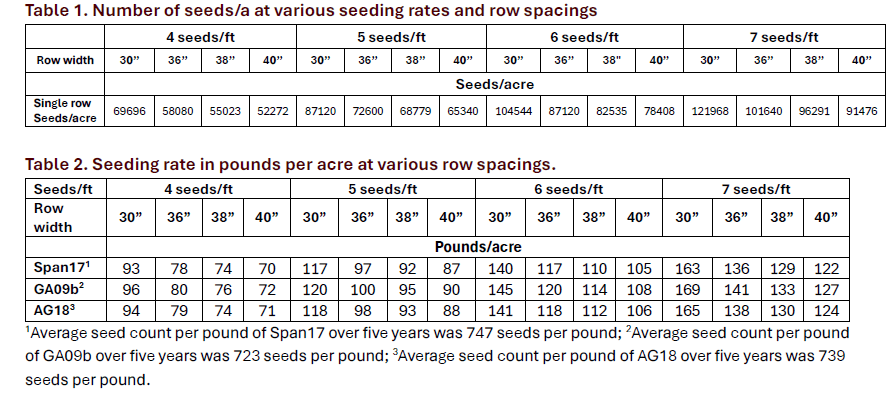
Table 1 lists the number of seeds required per acre for seeding rates ranging from 4 to 7 seeds/ft across various row spacings. For example, at a 30’ row spacing, 69,696 seeds/acre are required to achieve a seeding rate of 4 seeds/ft.
Target seeding rates in pounds/acre.
Table 2 lists the average seed counts/lb for common peanut varieties. Seed size varies significantly by market type (e.g., Runner, Spanish, Virginia, and Valencia), varieties, and specific seed lot. For example, seed count/lb of Span17, GA09b, and AG18 are approximately 747, 723, and 739 seeds/lb, respectively. However, because these numbers fluctuate between seed lots, always refer to the seed tag on the bag for the most accurate data. Use the specific count listed on the tag to calculate the pound/acre required for your row spacing.


Leave a Reply