Emi Kimura1, Jourdan Bell1, and Vanessa Corriher-Olson2
1Extension Agronomist and 2Extension Forage Specialist-Texas A&M AgriLife Extension Service.
It is important to always consider your cover crop objective before initiating grazing including how much biomass you plan to leave and thus when to terminate. Forage production depends on the fertilization practices and moisture availability. A good rule of thumb for grazing is not to release livestock until the plants are 6 – 8 inches tall with a good root system (as in winter small grains), but it is also essential to consider the livestock size and class because of varying daily forage requirements. Depending on the cover crop species used (e.g., grasses, legumes, or mixes), forage nutritive values will differ. Also, if you plan to provide supplemental feed, you can stretch the grazing duration of the cover crop forage. We will use Figure 1 to understand the process of determining stocking rates.
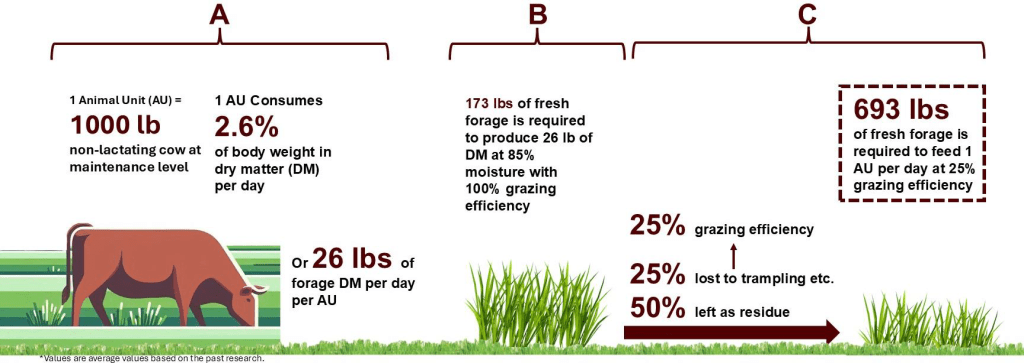
Figure 1. As-fed quantity of forage is significantly greater than the dry matter basis of forage. Values in the illustration are average values based on the historical research (Illustration credit: Dr. Emi Kimura).
FIGURE 1A: DAILY CONSUMPTION
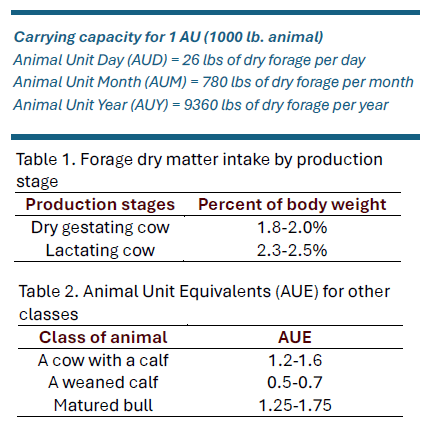
Beef cattle may consume 2.6% of their body weight in dry matter (DM) per animal unit equivalent (1 AUE = a mature, non-lactating cow weighing 1000 lb. and fed at a maintenance level). Please refer to table 1 and 2 for other production stages and classes of cattle. It is important to accurately consider the quantity of DM. One AU consumes 26 lbs of DM per day (AUD). Know that not every cow is 1 AU. It is important to accurately estimate AU based on animal weight.
Example: If there is a 1000 lb. animal (1 AU) on pasture who consumes 2.6% of its body weight, the animal would need:
1000 lb. x 0.026 = 26 lbs. of DM per day.
FIGURE 1B: MOISTURE CONTENT
Fresh plants, whether they are legume cover crop or grass species on small grain pasture, have a high moisture content. Moisture content can be measured by following methods.
1. Cut 3.5 oz of fresh forage. Ensure the sample uniformly represents leaves and stems. (*Can be a different weight, but need to know the fresh weight and replace the actual weight in the equation below.)
2. Air dry the forage in a paper bag in sunny location until the forage is dried out completely.
a. Alternatively, the fresh forage can be dried using the microwave for 1-2 minutes. It is easier to dry the forage if they are cut into short lengths.
3. Weigh the dry forage (DM).
4. Calculate moisture content using the following equation.
% Moisture content = [ (3.5 oz – DM)/3.5 oz] * 100
It is important to understand the as-fed quantity of forage is significantly greater than the DM available.
Example: Assume that the moisture content of forage is 85%. To obtain 26 lbs of DM, how much fresh forage is required?
26 lbs / (1-0.85) = 173 lbs of fresh forage is required to obtain 26 lbs of DM.
FIGURE 1C: GRAZING EFFICIENCY
With proper grazing, animals can consume 25% of total fresh forage due to many reasons, including insects and wildlife damage, trampling and more.
Example: At 25% grazing efficiency, how much fresh forage is required to obtain 26 lbs of DM to feed 1 AU for a day?
173 lbs of fresh forage / 0.25 = 693 lbs of fresh forage is required to obtain 26 lbs of DM at 25% grazing efficiency.
EXAMPLE
There are 100 calves each at 400 lb. You have 100-acre field with 1000 lb. of fresh forage per acre. How many days can the pasture support the 100 calves?
1. What is the AU of the herd?
(100 calves x 400 lb. each)/1000 lb. per 1 AU = 40 AU
2. What is the AUD of the herd? (How much dry forage per day does the herd require?)
40 AU x 26 lb. = 1040 lb. of dry forage per day (AUD)
3. What is the DM availability of the pasture at 85% moisture content?
(100-acre x 1000 lb./acre fresh forage) * (1-0.85) = 15,000 lb. DM available at 85% moisture content
4. What is the final DM availability of the pasture at 25% grazing efficiency?
15,000 lb. x 25% grazing efficiency = 3750 lb.
5. How many days would the pasture support the herd?
3,750 lbs / 1040 AUD = 3.6 days
The pasture is sufficient to support 100 calves (400lb. ea.) for 3.6 days.
The stocking rate should be based on potential forage intake and total animal weight rather than the numbers of animals. It is important to consider that forage production will increase as long as the field is not overstocked, and calculated intake in the example is an estimate. Be conservative when estimating the DM because this is a cover crop. Estimate for less DM rather than more DM because you do not want to overgraze the cover crop.
 TEXAS A&M AGRILIFE ROLLING PLAINS AGRONOMY PROGRAM
Leave a comment