
USING GLYPHOSATE (ROUNDUP) AND/OR GLUFOSINATE (LIBERTY) TO CONTROL VOLUNTEER PEANUTS 2024
James Grichar (PI) and Emi Kimura (Editor)
Funding source: Texas Peanut Producers Board/National Peanut Board
Funding year: 2024
INTRODUCTION
Volunteer peanuts can be a problem in a follow-crop situation. During the spring/ early summer of 2024, I received several calls on controlling peanuts prior to planting sesame. Volunteer peanuts can not only interfere with planting of other crops, such as sesame, but can also take needed water and nutrients from the soil. I have not had good success in controlling peanuts with glyphosate but glufosinate has effectively controlled peanut (author’s personal observations). Since questions arose about the rate of glyphosate or glufosinate required to effective control volunteer peanut, glyphosate and glufosinate alone and/or in combination were evaluated on planted peanut to determine their effectiveness.
MATERIALS AND METHODS
Field studies were conducted during the 2024 growing season at the Texas A&M Agrilife Research site located near Yoakum in south Texas to evaluate the effects of glyphosate (4.0 lb/gal formulation) at 16 and 32 oz/a, glufosinate (2.34 lb/gal formulation) at 16, 24, and 32 oz/a, and combinations of glyphosate + glufosinate each at 16 oz/a, and glyphosate at 16 oz/a + glufosinate at 24 oz/a. This study was arranged as a complete random design with 3 replications. An untreated check was included for comparison.
Soils at the Yoakum study site were a Tremona loamy fine sand with pH of 7.6. Plot size was 2 rows (38” spacing) by 30’ long. Spray applications were made with a CO2-pressurized backpack sprayer with a handheld boom equipped with TeeJet DG 11002 spray nozzles calibrated to deliver a total spray volume of 20 gal/A. This test was planted into excellent moisture on June 14 with SPAN-17 at the rate of 90 lbs/A and was not harvested for yield. Peanuts were planted approximately 1 ½ inches deep. Glyphosate and glufosinate were applied July 3 when peanuts were 19 days old and approximately 2 ½ to 3 inches tall.
RESULTS AND DISCUSSION
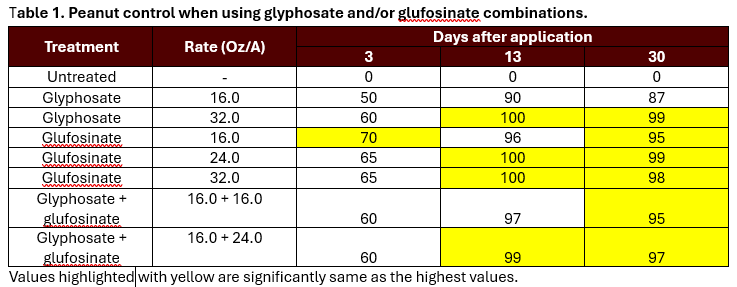
Glyphosate + glufosinate combinations were no better than glyphosate alone at 32.0 oz/a (Table 1). At the 13 DAT evaluation, only glyphosate at 16 oz/a controlled peanut <96%. At the 30 DAT evaluation, all treatments, with the exception of glyphosate at 16 oz/a controlled peanut > 95%. Several variables can affect the ability of glyphosate and/or glufosinate to control peanuts. Volunteer peanuts will emerge from all depths while these planted peanuts were planted 1 ½ inches deep. No data is available on the effect of peanut control with glyphosate or glufosinate applied to peanuts emerging from various depths. Also, the size of the peanut plant at the time of herbicide application will have an effect on control. Volunteer peanuts emerging from various depths will be at various sizes under normal growing conditions.
Conclusion
To effectively control volunteer peanuts glyphosate rate should be > 32 oz/a while glufosinate rate needs to be > 24 oz/a.
 TEXAS A&M AGRILIFE ROLLING PLAINS AGRONOMY PROGRAM
Leave a comment