
Control of Palmer Amaranth in South Texas Peanuts 2024
Josh McGinty (PI), James Grichar (PI), and Emi Kimura (Editor)
Funding source: Texas Peanut Producers Board/National Peanut Board
Funding year: 2024
INTRODUCTION
Brake herbicide (active ingredient fluridone) is a Group 12 herbicide for preemergence control of weeds in peanut. According to label precautions, it may cause temporary bleaching, stunting, or necrosis in untested peanut cultivars. In 2023, late season injury in the form of chlorosis (“yellow flash”) was observed with Brake treatments, exacerbated by higher rates. The objective of this study was to evaluate the efficacy of PRE and PRE + postemergence (POST) herbicide programs for season-long control of key weed species and to further investigate peanut response to Brake herbicide.
MATERIALS AND METHODS
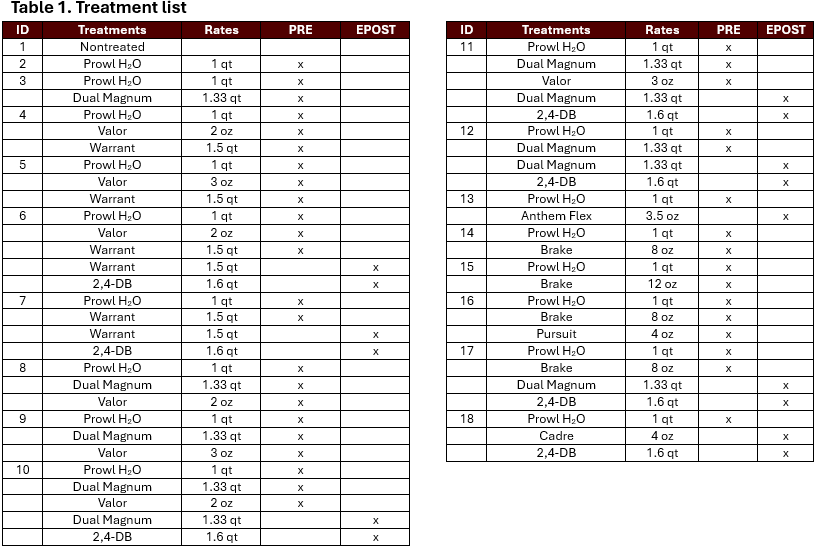
A field study was conducted in 2024 in an irrigated peanut field near Pearsall, TX. Soil at the study site was a Duval very fine sandy loam. The trial included eighteen treatments and was arranged as a randomized complete block with three replications. Plots were two rows (38” spacing) wide by 30 ft long. The field was planted to Georgia 09B peanut on June 6, 2024. Preemergence (PRE) treatments were made two days later on June 8, 2024. Early postemergence (EPOST) applications were made on July 17, 2024, 39 days after PRE applications were made. Applications were made with a CO2 pressurized backpack sprayer with a handheld spray boom equipped with TeeJet Drift Guard 11002 spray nozzles calibrated to deliver a total spray volume of 20 (PRE) or 15 (EPOST) GPA.
RESULTS AND DISCUSSION
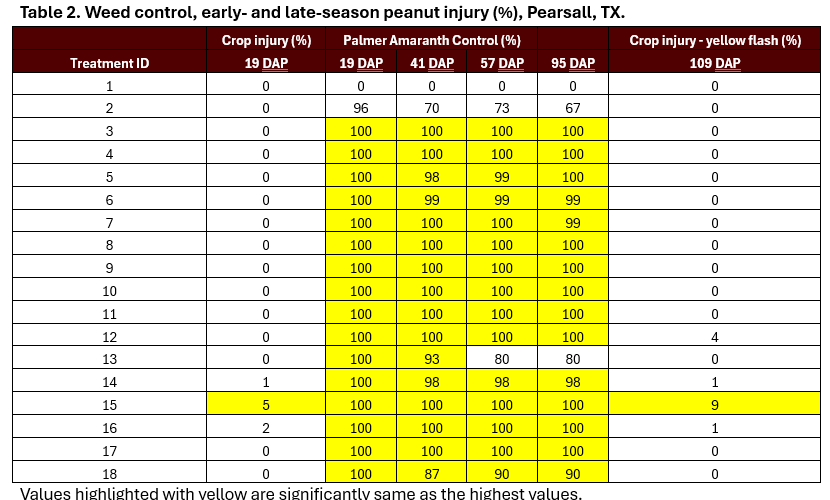
At 19 days after planting, slight bleaching was observed in seedling peanuts with treatments including Brake (Table 2). Peanut quickly grew out of this early season bleaching and was not observed again. Control of Palmer amaranth was excellent (98-100%) with all treatments other than Prowl H2O alone (96%). Palmer amaranth was the primary weed species present in nontreated plots and was the sole weed species rated for the duration of the study. At the time of EPOST applications (39 DAP), control of Palmer amaranth remained excellent, except for treatments consisting of Prowl H2O alone (70-87%). Sixteen days after EPOST applications were made (57 DAP), control of Palmer amaranth was excellent (90-100%) with all treatments except for Prowl H2O PRE followed by Anthem Flex EPOST (80%) and Prowl H2O PRE (73%). A similar trend was seen at the next evaluation (95 DAP) (Table 2). Brake treatments exhibited slight chlorosis very late in the season (0-9%) (Table 2).
 TEXAS A&M AGRILIFE ROLLING PLAINS AGRONOMY PROGRAM
Leave a comment