Katie Lewis, Professor of Soil Chemistry and Fertility
Joseph Burke, Assistant Professor of Cropping Systems Agronomy
Emi Kimura, Associate Professor and Extension Agronomist
Josh McGinty, Associate Professor and Extension Agronomist
Christopher Cobos, Senior Research Associate
Nicholas Boogades, Ph.D. Student
Kaitlyn Anderson, M.S. Student
The Carbon Cycle
The carbon cycle is the process of carbon movement between plants, animals, soils, and the atmosphere (Fig. 1). Understanding how agricultural practices can contribute to the carbon cycle is increasingly important to increase carbon sequestration potential and reduce atmospheric carbon dioxide (CO2).
Carbon enters the atmosphere as CO2 through various processes such as the combustion of fossil fuel extracted by humans, animals, plants, and microbial respiration, and CO2 diffusion between the ocean’s surface and the atmosphere. Plants use atmospheric CO2 through the process of photosynthesis and store carbon in above and below-ground biomass (Fig. 2). Carbon can also flow into the soil through the leaking of plant roots (rhizodeposition) or decomposition of root materials. Animals may consume plants and return carbon to the soil as animal waste. The decomposition of crop residues (e.g., litter, cover crops) also moves plant carbon into the soil. Processes that absorb carbon from the atmosphere, such as plants, the ocean, and soil, are referred to as carbon sinks, while a carbon source is referred to as anything that releases more carbon into the atmosphere than it absorbs.

Figure 1. Carbon cycling in agricultural systems. Figure designed by Dr. Emi Kimura, 2024.
Carbon Farming
USDA Climate Hubs defines carbon farming as the use of specific on-farm practices designed to take carbon out of the air and store it in soils and plant material (carbon sequestration). Such practices include application of soil amendments (e.g., compost and biochar), conservation tillage, and cover crops. The efficacy of each carbon farming practice on carbon sequestration potential can vary widely by environments, soil textures, crops, cropping systems, and interactions of all. What are the important factors that would affect carbon sequestration potential in the semi-arid environment?
Drivers of Sequestration – Environment and Management
The environment largely drives carbon sequestration potential. Climate (precipitation and temperature) and soil texture are two primary environmental factors influencing atmospheric CO2 capture, decomposition rates, and storage potential (Fig. 2). With limited precipitation, less plant growth occurs, decreasing the amount of CO2 captured through photosynthesis. Sandy soil offers less protection to added organic matter (limited aggregate formation), which results in more rapid decomposition and less long-term storage potential for soil organic carbon.
Field studies conducted near Lamesa, TX, indicate that over 75% of profile carbon stocks are below the six-inch soil depth (Fig. 2). This indicates that most profile soil carbon is recalcitrant and resistant to change, even with shallow tillage. Another study conducted in Lubbock, TX, showed that the use of no-tillage alone did not increase soil organic carbon (Fig. 3). However, the inclusion of a wheat cover crop during the winter-fallow period with no-tillage significantly increased soil organic carbon in the 0-4 and 4-8 inch depths. The research demonstrated the need for additional biomass production beyond the main crop to increase carbon stocks.
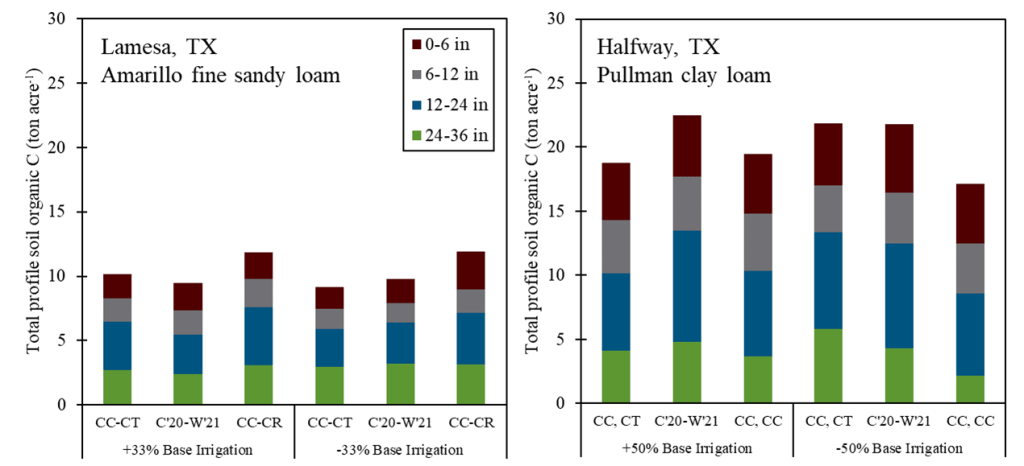
Figure 2. Total profile soil organic C to a 36-inch depth at the Lamesa and Halfway, TX, research sites established in 2014 and 2013, respectively. CC-CT denotes continuous cotton using conventional tillage; C’20-W’21 denotes a cotton-wheat-fallow system using no-tillage; and, CC-CR (or CC) denotes continuous cotton using a winter cover crop and no-tillage. Figure designed by Dr. Joseph Burke, 2022.
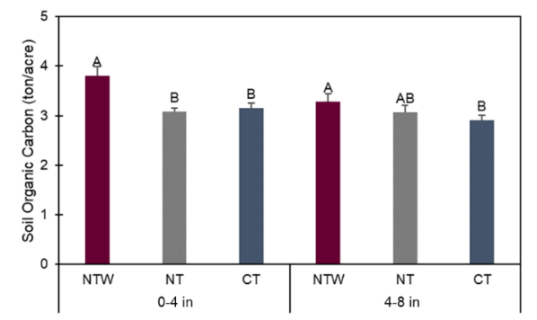
Figure 3. Cover crop and tillage impacts on SOC (ton/A) at 0-4” and 4-8” depths. NTW denotes no-till with a winter wheat cover crop; NT denotes no-till without a cover crop; and, CT denotes conventional tillage and winter fallow. Figure designed by Dr. Mark McDonald, 2021.
Funding Statement
This work is supported by the Sustainable Agricultural Systems Program grant no. 2021-68012-35897 from the USDA National Institute of Food and Agriculture. Any opinions, findings, conclusions, or recommendations expressed in this publication are those of the author(s) and do not necessarily reflect the view of the U.S. Department of Agriculture.
 TEXAS A&M AGRILIFE ROLLING PLAINS AGRONOMY PROGRAM
Leave a comment