
Emi Kimura (Editor) and James Grichar (PI)
Funding source: 2023 Texas Peanut Producers Board/National Peanut Board
INTRODUCTION
Weeds interfere with peanut through direct competition for light, soil water, nutrients, essential gases, and space and can also interfere with peanut growth through allelopathy. Weeds associated with peanut production are predominantly comprised of annual herbaceous species that are propagated by seeds. Because of the disturbance of soil during land preparation and the use of conventional and reduced tillage before planting, not only small-seeded weed species {e.g. Amaranthus spp., eclipta [Eclipta prostrata L.], goosegrass [Eleusine indica (L.) Gaertn.], crabgrass (Digitaria spp.}, but also large seeded species can successfully emerge from deeper in the soil {e.g. Texas panicum [Urochloa texana (Buckl.) R. Webster], sicklepod [Senna obtusifolia (L.) H.S. Irwin & Barneby], morningglories (Ipomoea spp.) and common ragweed (Ambrosia artemisiifiolia L.). Most of these weed species have temperature and soil moisture germination requirements similar to peanut and this favors their emergence and establishment before peanut canopy closure. Perennial weed species are fairly common in peanut fields and those that are successful frequently produce vegetative propagules such as tubers and rhizomes {e.g. bermudagrass (Cynodon dactylon L.), nutsedge (Cyperus spp.) and johnsongrass [Sorghum halepense (L.) Pers.]}, which can be greatly reduced with the use of tillage and cultivation.
Weed management in peanut is challenging because of the prostrate growth habit of the peanut plant which allows weeds to become established if weed control practices are not properly implemented. Weed control can be influenced by the ability of peanut to compete with weeds, cultural practices that minimize the soil seed bank and weed infestation, mechanical practices such as primary tillage prior to planting, cultivation during the growing season, and also by efficacy of herbicides.
Anthem Flex® contains 3.733 lb ai/gal of pyroxasulfone and 0.267 lb ai/gal of carfentrazone and was released in 2020 as a premix herbicide combination produced by the FMC Corporation for use in peanut. Pyroxasulfone is the active ingredient in Zidua® while carfentrazone is the active ingredient in Aim®. Zidua is registered for use in peanut as an early postemergence (EPOST) application and controls annual grasses such as crabgrass, Coloradograss, goosegrass and crowfootgrass as well as broadleaf weeds such as the pigweed species. Although Zidua has a similar weed control spectrum as Dual Magnum and Outlook, it has a higher specific activity allowing for use rates approximately eight times lower than Outlook. Anthem Flex is presently cleared for use in corn, cotton, lentil, soybean, and wheat and was cleared for use in peanut in 2020. The objective of this research was to determine the spectrum of weed control in the south Texas production areas with Anthem Flex systems.
MATERIALS AND METHODS
Field studies were conducted in 2023 at the Texas A&M Agrilife Research site located near Yoakum in south Texas to evaluate weed control in peanut with Anthem Flex herbicide systems. All studies was arranged as a randomized complete block design with 3 replications. An untreated check was included for comparison.
Soils at the Yoakum study site was a Tremona loamy fine sand with pH of 7.6. Plot size was 2 rows (38” spacing) by 30’ long. Spray applications were made with a CO2-pressurized backpack sprayer with a handheld boom equipped with TeeJet DG 11002 spray nozzles calibrated to deliver a total spray volume of 20 gal/A. Herbicide application timings were: preemergence (PRE), applied the same day as planting (6/12); peanut cracking (CRACK), applied 10 days after plant (DAP); postemergence (POST), applied 25 DAP.
This test area was not irrigated and was planted into excellent moisture on June 12 with Georgia 09B at the rate of 90 lbs/A. Rainfall events after planting were 0.57 inch on June 21, 0.48 inch for July, and 0.34 inch for August. This test was not harvested for yield.
RESULTS AND DISCUSSION
Peanut injury. Postemergence applications of Anthem Flex resulted in minor leaf burn that was present for 10 to 14 days after application. The new growth did not show any effects (data not shown). Aim alone will also cause a similar type of leaf burn so this leaf burn can be attributed to the carfentrazone (Aim) in the premix.
Weed control.
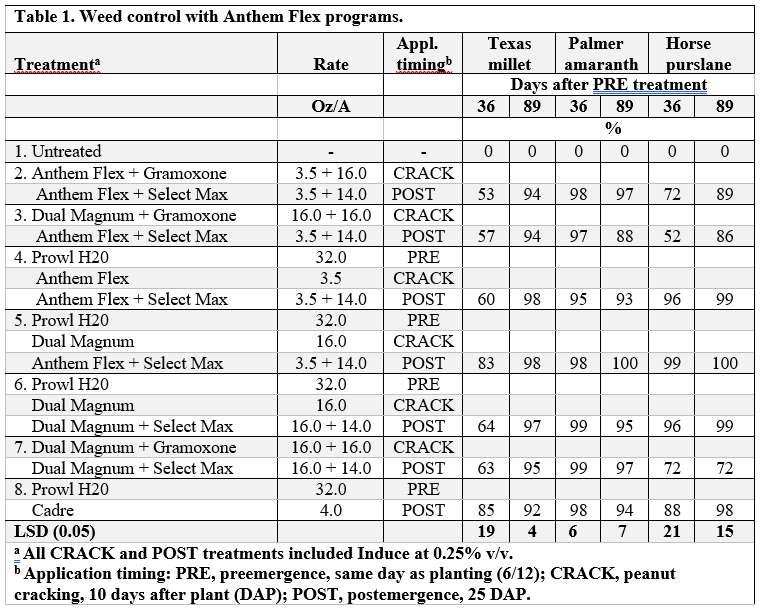
Coloradograss (Texas millet). When evaluated 36 days after PRE treatment (DAT) any herbicide system which included Prowl H2O applied PRE provided 60 to 85% control while systems that included Anthem Flex applied at CRACK and POST provided 53 to 57% control (Table 1). The Dual Magnum only treatment controlled Texas millet 93%. At the 89 DAT evaluation, all herbicide systems controlled Texas millet > 92%. All systems, except Prowl H20 followed by Cadre applied POST, contained Select at 14.0 oz/A applied POST and this helped improved control millet control. Typically Anthem Flex alone will not control Texas millet season-long and will need a herbicide such as Select to provide control of annual grass escapes.
Palmer amaranth. At the 36 DAT evaluation, all herbicide systems controlled Palmer amaranth > 95% (Table 1). At the 89 DAP evaluation, the herbicide system which contained Prowl H2O applied PRE followed by (fb) Dual Magnum applied CRACK fb Anthem Flex + Select applied POST provided perfect (100%) control. All other herbicide systems, with the exception of Dual Magnum + Gramoxone applied at CRACK fb Anthem Flex + Select applied POST controlled Palmer amaranth > 93%.
Horse purslane. At the 36 DAT evaluation, only those systems which include Prowl H2) applied PRE controlled this weed at least 88% (Table 1). all herbicide systems, with the exception of Dual Magnum + Gramoxone CRACK fb Anthem Flex + Select POST provided 78 to 97% control while at the 126 DAT evaluation, Prowl H20 + Cadre POST provided 100% control while Anthem Flex systems provided 58 to 87% control (Table 1).
CONCLUSION
Control of annual grasses such as Texas millet can be erratic with Anthem Flex and will require the use of a postemergence grass herbicide such as Select or Poast Plus to improve season-long control. Anthem Flex will provide excellent season-long control of Palmer amaranth, horse purslane, and smellmelon, which are broadleaf weeds that can cause Texas peanut growers considerable problems and can be hard-to-control with some herbicides. This premix will control ALS- (WSSA Group 2 herbicides) and glyphosate- (WSSA Group 9 herbicides) resistant Palmer amaranth, which is becoming more widespread across the Texas peanut producing areas.
 TEXAS A&M AGRILIFE ROLLING PLAINS AGRONOMY PROGRAM
Leave a comment