
Emi Kimura (Editor) and James Grichar (PI)
INTRODUCTION
Paraquat (Gramoxone) is one of the most frequently used POST herbicides in the Southeastern US peanut production area but is seldom used in the South Texas peanut growing area because of noticeable crop injury which may occur reducing yield and grade characteristics. In the southeast, peanut tolerance and differences in cultivar tolerance to paraquat was first noted in the late 1970’s and paraquat has become a standard herbicide component of most herbicide programs used in the southeast. The Gramoxone label also states that paraquat must be applied no later than 28 day after emergence (DAE) to avoid significant foliar damage to peanut. Peanut injury with paraquat can be reduced and the flexibility of the application window increased by tank-mixing bentazon with paraquat. The addition of bentazon to paraquat may either be antagonistic or synergistic in its effect on weed control depending on the weed species and herbicide rate and often does not improve peanut yield despite the reduction in crop injury. Since it is a fairly cheap herbicide to apply I have always thought that paraquat may have a place in the south Texas weed control arsenal. This research was conducted to evaluate peanut response to paraquat applied at different timings under our south Texas growing conditions.
MATERIALS AND METHODS
Field studies were conducted at the Texas A&M Agrilife Research site located near Yoakum in south Texas to evaluate Georgia 09B response to paraquat applied 14 and/or 28 days after cracking (DAC). All studies was arranged as a randomized complete block design with 3 replications. An untreated check was included for comparison.
Soils at the Yoakum study site was a Tremona loamy fine sand with pH of 7.6. Plot size was 2 rows (38” spacing) by 30’ long. Spray applications were made with a CO2-pressurized backpack sprayer with a handheld boom equipped with TeeJet DG 11002 spray nozzles calibrated to deliver a total spray volume of 20 gal/A. Georgia 09B was planted on June 12. Gramoxone was applied at 10.8 fl oz/A (1X) and 21.6 fl oz/A (2X) at two different timings, 14 days after cracking (DAC) and 28 DAC. Dual Magnum was also added to some Gramoxone mixes and Gramoxone + Dual Magnum + Basagran was the standard. Sprinkler irrigation was applied as needed. Rainfall events after planting were 0.57 inch on June 21, 0.48 inch for July, and 0.34 inch for August.
RESULTS AND DISCUSSION
Due to the excessive dry conditions, deer moved into the tests and completely decimated these studies. Since we had the only green plant material for miles around the deer were attracted to the area. I was able to get early-season injury ratings and stand reduction evaluations during the season but was not able to get yield.
Peanut leaf burn. Initial peanut leaf burn with Gramaxone varied considerably and leaf burn decreased as the application was delayed from 14 to 28 DAC (Table 1). Adding Basagran to the mixture resulted in no leaf burn. Typically, leaf burn is seen with Gramaxone and this injury is transient and any new growth does not show this burn.Peanut stunting. Stunting was also more prominent with the 14 DAC application and was more noticeable when Dual Magnum was added to the mix (Table 1).
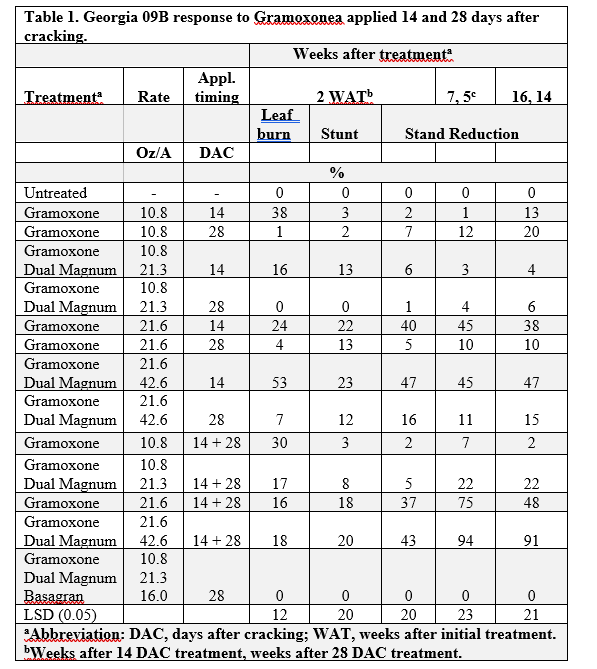
Stand reduction. Stand reduction was the major issue with the application of Gramoxone. When evaluated 2 weeks after herbicide application (WAT), Gramoxone at the 1X rate applied either alone or in combination with Dual Magnum either 14 or 28 DAC resulted in 1 to 7% stand reduction (Table 1). A sequential application (14 + 28 DAC) of Gramoxone (1X) alone resulted in a 2% reduction in stand while Gramoxone (1X) + Dual Magnum (1X) applied sequentially resulted in a 5% reduction in stand. However, the 2X rate of Gramoxone produced a 40% stand reduction when applied 14 DAC. When applied 28 DAC, the 2X rate only reduced stand 5%. When a 2X rate of Dual Magnum was added to the 2X rate of Gramoxone, stand reduction was 47% when applied 14 DAC and was reduced to 16% when applied 28 DAC. When sequential applications of Gramoxone (2X) alone or in combination with Dual Magnum (2X) were evaluated, stand reduction was > 37%. Adding Basagran to the Gramoxone (1X) + Dual Magnum (1X) combination did safen the mixture and there was not stand reduction.
Similar trends were seen at the next two evaluations and with the sequential applications of the 2X rate of Gramoxone alone or in combination with a 2X rate of Dual Magnum stand reductions actually increased. The 2X rate of Gramoxone + Dual Magnum arpplied sequentially resulted in very little peanut stand at the last two evaluations.
DISCUSSION
Although Gramoxone is used in other areas of southwestern peanut growing region (the Texas High Plains, Oklahoma) without issues, the south Texas area has always had problems with its use. In fact, the Syngenta reps discourage its use due to the potential for the issue covered in this discussion. The results of this study farther confirms potential problems with the use of Gramoxone in the south Texas peanut growing area.
 TEXAS A&M AGRILIFE ROLLING PLAINS AGRONOMY PROGRAM
Leave a comment