
Emi Kimura (Editor) and James Grichar (PI)
INTRODUCTION
Brake received registration for use in peanut in the latter part of January 2023 and is not a stand
alone herbicide and must be included in a program approach. Also, Brake needs at least 0.5” of rainfall and/or irrigation after application to perform up to its potential.
The Brake (fluridone) label states that the product should not be used on ‘Spanish’ or ‘Valencia’ type peanut. Also, the label states that Brake has only been tested on GA-06G, GA-16HO, GA-18RU, GA-20VHO, AUNPL-17, TIFNV HIGH O/L, FLORUN 331, GA-16HO peanut varieties. GA-16HO may exhibit more visual injury (e.g. bleaching, stunting, necrosis) following an application than the other cultivars tested but the injury is transient and plants typically outgrow the effects and typically outgrow the effects and develop normally without yield loss.
In the southeast it has been reported that Brake will cause some peanut injury in the form of stunting and bleaching especially when higher rates are used and wetter conditions prevail. This research was conducted to evaluate peanut variety response to Brake under our south Texas growing conditions.
MATERIALS AND METHODS
Field studies were conducted at the Texas A&M Agrilife Research site located near Yoakum in south Texas to evaluate peanut cultivars [Georgia 09B, TX 212-03-03, TX 144370 (Murray), and Diesel Nut] response to Brake applied preemergence (PRE) at 12, 16, and 32 oz/A. All studies was arranged as a randomized complete block design with 3 replications. An untreated check was included for comparison. These cultivars represent commonly used cultivar (Georgia 09B) along with cultivars that are expected to be released in the next few years.
Soils at the Yoakum study site was a Tremona loamy fine sand with pH of 7.6. Plot size was 2 rows (38” spacing) by 30’ long. Spray applications were made with a CO2-pressurized backpack sprayer with a handheld boom equipped with TeeJet DG 11002 spray nozzles calibrated to deliver a total spray volume of 20 gal/A. Georgia 09B was planted on June 12 while TX 212-03-03, TX 144370 (Murray), and Diesel Nut were planted on June 26. Brake was applied preemergence (PRE) on June 16 to Georgia 09B and on June 28 to the other 3 cultivars. Sprinkler irrigation was applied as needed. Rainfall events after planting were 0.57 inch on June 21, 0.48 inch for July, and 0.34 inch for August.
RESULTS AND DISCUSSION
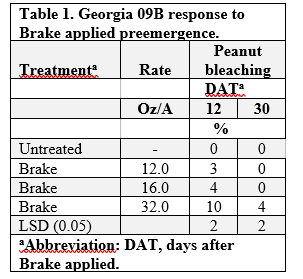
Due to the excessive dry conditions, deer moved into the tests and completely decimated these studies. Since we had the only green plant material for miles around the deer were attracted to the area. I was able to get early-season injury ratings from the Georgia 09B tests but the other 3 studies were taken out by deer soon after planting and before peanut emergence.
Peanut injury. Brake injury manifested itself in the form of leaflet bleaching and was present for approximately and eventually the new growth did not show any effects. At the 12 days after treatment (DAT) evaluation, peanut bleaching from Brake increased as the rate of Brake increased while (Table 1). ll herbicide systems which included Brake resulted in 1 to 4% leaf bleaching when evaluated 15 days after herbicide treatment (DAT) (Table 1). When evaluated again 35 DAT no bleaching on the peanut leaves was noted.
DISCUSSION
The label states that the application of Brake followed by conditions that do not promote normal growth and development, or cause stress (e. g. cold temperatures), saturated soil conditions, excessive irrigation or rainfall may result in crop injury. Injury seen on Georgia 09B in this study is similar to reports from Georgia and actually the leaf bleaching seen in this study is less than reported in those areas. Also, although not seen in this study, peanut stunting has been reported in the southeast. However, in those studies, no yield reductions have been noted with any Brake applications.
 TEXAS A&M AGRILIFE ROLLING PLAINS AGRONOMY PROGRAM
Leave a comment