
Emi Kimura (Editor) and Katie Lewis (PI)
Funding source: Texas Peanut Producers Board/National Peanut Board
Funding year: 2023
INTRODUCTION
To achieve the best quality and highest yields, peanut farmers must develop nutrient management plans to ensure the plant has the nutrients it needs. While all nutrients are important, manganese (Mn deficiency can reduce yield. Manganese deficiency is quite common in more alkaline soil, such as in semi-arid environments. In the basic to alkaline soil of Texas’ Southern High Plains, calcium and magnesium (Mg) are present in high quantities, which can induce Mn deficiency even if soil tests indicate high levels of Mn. This will result in low yields, low grades, and poor germination. High levels of Mg exist in irrigated fields with sandy soil, and preliminary observations depict Mg-induced Mn deficiency in peanuts in Gaines and Yoakum Counties, TX. Since soil testing often indicates adequate Mn, it is difficult to justify the application of Mn fertilizer. Research was aimed at evaluating methods and frequency of Mn application to alleviate deficiency symptoms.
MATERIALS AND METHODS
Trials were conducted in Lubbock, TX, to evaluate the effect of Mn fertilizer applied as Till It Mn (5%) (4-0-4-5 Mn). The study was designed as a randomized complete block with a factorial arrangement including main factors of in-furrow rates (0, 2, 4, and 6 qt/A) and foliar application frequency (0, 1x, and 2x). Treatment combinations were replicated 6 times. Nitrogen and potassium were balanced across all treatments. Foliar applications were sprayed on 24 July 2023 (pegging) and 22 August 2023 (nut filling); 1x treatments were applied at 1 qt/A and 2x applications were applied at 0.5 qt/A. Georgia 09-B peanuts were planted at 5 seed/ft on 9 May 2023 in Lubbock. Soil samples collected prior to preplant fertilizer applications were sent to Ward’s Laboratory (Kearney, NE) for macro- and micronutrient determination. Peanuts were dug on 3 November 2023 and harvested on 8 November 2023.
RESULTS AND DISCUSSION
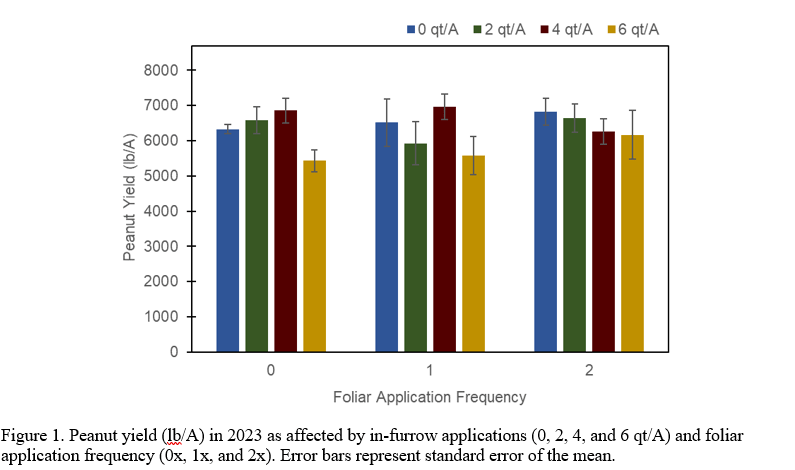
Soil characterization data for the Lubbock location is reported in Table 1. Soil pH was moderately alkaline and ranged from 8.10 to 8.28 pH with the shallowest depth being the most alkaline. It is well above what is considered optimum for peanuts (5.8 to 6.2 pH) (HGIC 1315, Clemson Fact Sheet). At this alkaline pH, the availability of micronutrients can be limited; however, in the 0-6” depth, iron (Fe), Mn, copper (Cu), and zinc (Zn) are rated as high (ratings based on the Texas A&M AgriLife Extension Soil, Water, and Forage testing laboratory). Phosphorus (P) is rated as very low in the 0-6” soil depth, and potassium (K), sulfur (S), calcium (Ca), and magnesium (Mg) are well above the sufficiency range rated as high or very high. The interaction of Mn in-furrow and foliar applications did not affect peanut yield; however, the main factor of in-furrow application rate did. Specifically, if evaluated without adding a foliar application (0x), the 4 qt/A rate increased peanut yield more than other rates. Manganese toxicity can reduce yield, as observed with the 6 qt/A rate regardless of foliar applications. Overall, the combination of 4 qt/A in-furrow and 1x foliar application numerically increased peanut yield compared to other treatments. Research will be continued in 2024.

 TEXAS A&M AGRILIFE ROLLING PLAINS AGRONOMY PROGRAM
Leave a comment