
Emi Kimura (Editor), Paul DeLaune (PI), and Katie Lewis (PI)
Funding source: Texas Peanut Producers Board/National Peanut Board
Funding year: 2023
INTRODUCTION
Cover crops have received renewed attention in recent years due to heightened awareness of soil health. Terms such as soil health, regenerative agriculture, resilient agriculture, and sustainability are commonly used across a broad spectrum of public media outlets. Soil health promoting practices often include conservation tillage, crop rotation, and cover crops. Many studies have noted the benefit of such practices over the long-term. However, research has also noted that reverting to conventional tillage can rapidly deplete the benefits captured by soil health promoting practices. Thus, soil health promoting practices within peanut systems is difficult to sustain due to the nature of the system. Producers have expressed interest in implementing conservation tillage and cover crops within peanut systems to improve soil health. As with any other crop, questions exist on the feasibility of reduced tillage and cover crops and subsequent impact on crop performance. The objective of this study was to evaluate the effect of cover crops on peanut stand establishment, yield, and soil health indicators.
MATERIALS AND METHODS
Trials were conducted at the Texas A&M AgriLife Research and Extension Center at Vernon on a Miles sandy loam soil. And the Texas A&M AgriLife Research and Extension Center at Lubbock on an Olton clay loam soil. Due to rotation, studies conducted in 2023 were completed under pivot irrigation at Vernon and furrow irrigation at Lubbock. The site at Vernon had been under no-till wheat from 2001-2018 until ground was tilled for peanut work in 2019. Peanuts were planted in 2023 following cotton at each location. After cotton harvest in 2022, cover crops were planted using a no-till drill in a complete randomized black design with four replications. Cover crop treatments included 1) control (no cover crop); 2) cereal rye planted at 30 lb/ac; 3) radish planted at 10 lb/ac; 4) Rye/hairy vetch mixture (25/5 lb/ac); and 5) rye/hairy vetch/radish (25/3/2 lb/ac). These same treatments were duplicated in Lubbock. In Vernon, cover crops were terminated on April 26 using glyphosate. A roller crimper was used to terminate cover crops, but was not a total success due to reduced residue levels. Peanuts (ACI 236) were planted on May 18th under no-till conditions at Vernon. This planting date was later than planned due to extensive tornado damage at the Center on May 4. Due to lack of power to the pivot, peanuts were planted under drier conditions than ideal. Cover crop herbage mass and plant stands after emergence were quantified. Measurements were taken for microbial biomass and community analysis, soil carbon, soil nutrients, soil moisture, and GHG emissions. Prior to termination, plots were clipped to determine cover crop herbage mass production. Peanuts were dug in Vernon on October 13. After digging, rainfall events became an issue and prevented harvesting until November 16. Many of the peanuts at Vernon had mold damage and were not suitable for grading.
RESULTS AND DISCUSSION
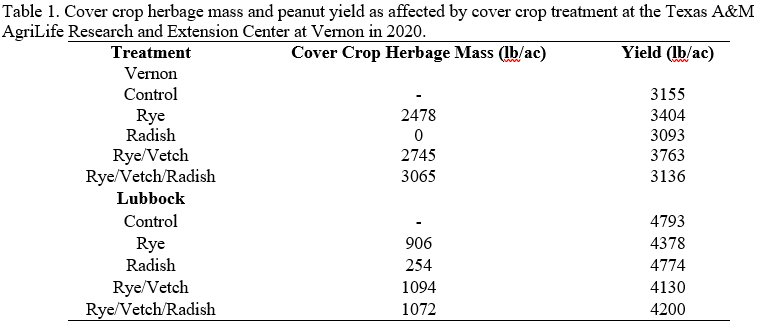
Cover crop herbage mass and yield are provided in Table 1. Rye was the dominant species in mixtures, with all cover crop treatments 100% rye at termination at Vernon as radishes and vetch did not over winter. Thus, radish was a complete failure at Vernon and resulted in significantly less biomass at Lubbock (Table 1). The rye only cover crop resulted in similar biomass as mixed cover crops at each location. Cover crop biomass production was greater at Vernon and thus created more standing residue at planting. Stands were below average at Vernon, which may be partly explained by dry conditions and no capability to irrigate plots due to a loss of power from tornado damage at the Vernon Center (Figure 1). However, the lowest stands were from the control and radish plots (Figure 1 and 2). As both of these treatments provided no residue cover due to either the planting of no cover crop or winter-kill of radishes, cover crop residue did not affect peanut stands in a negative aspect when planted under no-till conditions. Peanut yields were not significantly affected by treatment at either location (Table 1). At Vernon, numerically higher yields were observed with rye and rye/vetch cover crops. At Lubbock, numerically higher yields were observed for the control and low biomass producing radish. In the past, numerically lower yields at Lubbock have been hypothesized to be linked to incorporation of rye leading to nutrient immobilization and that furrow irrigation is not conducive to conservation tillage approaches. Unlike Lubbock, cover crop residue was not incorporated at Vernon under no-till management under pivot irrigation.


As noted in past reports, both small and large nodules have been noted on peanut roots at Vernon. In 2022, we conducted 16S-rRNA based nodule microbiome sequencing to characterize microbial communities in small and large sized nodules from the Vernon site. Microbial communities diverged drastically in the two types of peanut nodules (big and small). Core microbial analysis revealed that the big nodules were inhabited by Bradyrhizobium, which dominated composition (>99%) throughout the plant life cycle. Surprisingly, we observed that in addition to Bradyrhizobium, the small nodules harbored a diverse set of bacteria (~31%) that were not present in big nodules. Notably, these initially less dominant bacteria gradually dominated in small nodules during the later plant growth phases, which suggested that native microbial communities competed with the commercial inoculum in the small nodules only. Conversely, negligible or no competition was observed in the big nodules.
CONCLUSION
In summary, cover crops had no significant impact on peanut populations or yields within a no-till pivot system or conventional furrow irrigated system. Radish has not performed well as a cover crop, due to potential to winter kill under adverse conditions. In contrast to a conservation tillage system under pivot irrigation, little to no cover crop residue is retained on the surface under furrow systems due to incorporation. Rye dominated cover crops resulted in like yields compared to no cover crop treatments. Furrow irrigated systems have more obstacles to overcome and economic and logistical concerns should be carefully weighed before cover crop implementation in such systems. At Vernon, microbial communities varied greatly based on the size of the nodules. Based on the prediction of KEGG pathway analysis for N and P cycling genes and the presence of diverse genera in the small nodules, we foresee great potential of future studies of these microbial communities which may be crucial for peanut growth and development and/or protecting host plants from various biotic and abiotic stresses.
 TEXAS A&M AGRILIFE ROLLING PLAINS AGRONOMY PROGRAM
Leave a comment