
Emi Kimura (Editor) and James Grichar (PI)
Funding source: Texas Peanut Producers Board/National Peanut Board
Funding year: 2023
INTRODUCTION
Brake (fluridone) was developed in the early 1970’s and is a pigment inhibitor classified as a Weed Science of America Group 12 herbicide that has been used extensively to control submerged and floating weeds such as hydrilla [Hydrilla erticillate (L. f.) Royle] in aquatic environments. This mode of action has not been used in peanut very much. Fluridone was first investigated for use in cotton in the 1970’s and has shown good control of Amaranthus species, especially Palmer amaranth. However, potential carryover of fluridone to subsequent crops can be a concern. Research with fluridone during the 1970’s was with rates of 0.26 to 0.8 lb/A and it was found that preplant fluridone applied at 0.26 lb/A provided 89 to 95% control of redroot pigweed (Amaranthus retroflexus L.) and 85 to 100% control of black nightshade (Solanum nigrum L.) in cotton. Variable control of redroot pigweed was observed when fluridone was applied at 0.09 or 0.18 lb/A (30 to 86% and 61 to 100% control, respectively).
Brake received registration for use in peanut in the latter part of January 2023. Brake is not a stand alone herbicide and must be included in a program approach. Although the label states that only certain peanut varieties have been tested for tolerance to Brake we have seen no issues with GA 09-B which was planted in this study. Also, Brake needs at least 0.5” of rainfall and/or irrigation after application to perform up to its potential. Brake will cause some peanut injury in the form of stunting and bleaching especially when higher rates are used and wetter conditions prevail.
This research was conducted to evaluate the weed efficacy of Brake on weeds commonly found in the south Texas peanut production area. Of special interest is the ability of Brake to control Palmer amaranth.
MATERIALS AND METHODS
Field studies were conducted during the 2023 growing season at the Texas A&M Agrilife Research site located near Yoakum in south Texas to evaluate weed control in peanut with Brake herbicide systems. All studies was arranged as a randomized complete block design with 3 replications. An untreated check was included for comparison.
Soils at the Yoakum study site was a Tremona loamy fine sand with pH of 7.6. Plot size was 2 rows (38” spacing) by 30’ long. Spray applications were made with a CO2-pressurized backpack sprayer with a handheld boom equipped with TeeJet DG 11002 spray nozzles calibrated to deliver a total spray volume of 20 gal/A. This test was planted into excellent moisture on June 12 with Georgia 09B at the rate of 90 lbs/A and was not harvested for yield. All herbicides were applied preemergence (PRE) on June 13, one day after peanuts were planted. Rainfall events after planting were 0.57 inch on June 21, 0.48 inch for July, and 0.34 inch for August.
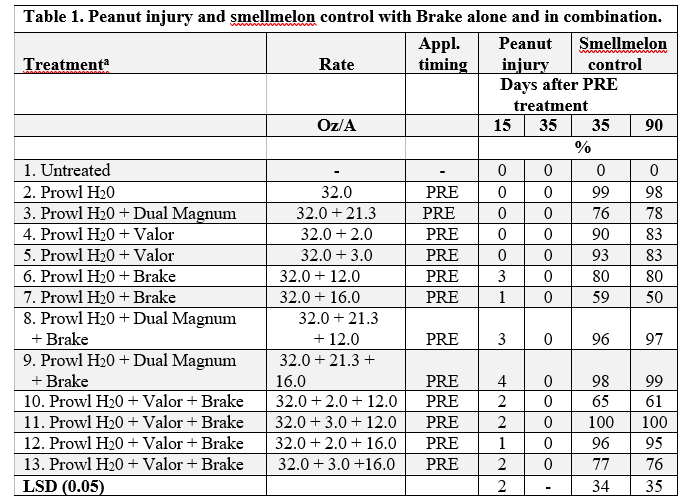
Peanut injury. All herbicide systems which included Brake resulted in 1 to 4% leaf bleaching when evaluated 15 days after herbicide treatment (DAT) (Table 1). When evaluated again 35 DAT no bleaching on the peanut leaves was noted. This is similar to reports from Georgia and actually the leaf bleaching seen in this study is less than reported in those areas. Also, although not seen in this study, peanut stunting has been reported in some areas.
Weed control
Smellmelon. When evaluated 35 days after PRE treatment (DAT) Prowl H20 alone controlled this weed 99% (Table 1). Prowl H20 + Valor systems provided 90 to 93% control, Prowl H20 + Brake systems 59 to 80% control, Prowl H20 + Dual Magnum + Brake systems 96 to 98% control, and Prowl H20 + Valor + Brake systems 65 to 100% control. At the 90 DAT evaluation control was similar to that seen at the 35 DAT evaluation. Typically, Prowl H20 will not provide extended control of weeds such as smellmelon as the seeds will germinate after each rainfall and/or irrigation event; however this test area wasirrigated and only 0.48 and 0.34 in of rain was received in July and August, respectively so there was not much moisture available for additional seed germination.
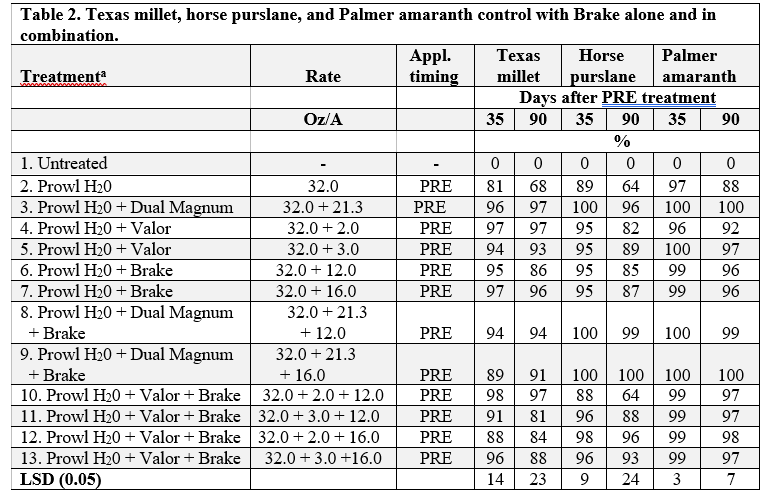
Coloradograss (Texas millet). At the 35 DAT evaluation, Prowl H2O alone provided 81% control while all other herbicide systems controlled Texas millet > 88% (Table 2). When evaluated 90 DAT, Prowl H2O alone controlled Texas millet 68% while Prowl H2O + Dual Magnum systems provided > 91% control. Adding Brake to any herbicide system resulted in Texas millet control which ranged from 81 to 97%. Large seeded weeds such as Texas millet are difficult to control season-long and may require the use of a graminicide later in the growing season.
Horse purslane. At the 35 DAT treatment evaluation, all herbicide systems with the exception of Prowl H2O alone or Prowl H2O + Valor at 2.0 oz/A + Brake at 12.0 oz/A provide > 95% control (Table 2). At the 90 DAT evaluation, all herbicide systems which include Prowl H2O + Dual Magnum provided 96 to 100% control. Adding Brake at 16.0 oz/A to Prowl H2O + Valor increased horse purslane to > 93%. Typically a late-season insect moves into the area in August and completely decimates horse purslane so at the end of the growing season no horse purslane is left. This event did not occur until mid- to late September this year.
Palmer amaranth. At the 35 DAT evaluation, all herbicide systems including Prowl H2O alone controlled Palmer amaranth > 96% (Table 2). At the 90 DAP evaluation, herbicide systems which included Brake controlled Palmer amaranth > 96% while Prowl H2O + Dual Magnum controlled this weed 100%. Only Prowl H2O applied alone controlled Palmer amaranth less than any of the Brake systems.
Conclusion
In most instances the addition of Brake did improve broadleaf weed control; however, as expected the addition of Brake did nothing to improve Texas millet control. Brake is not a stand alone herbicide and requires the addition of herbicides such as Prowl H20, Dual Magnum, or Valor to provide complete and season-long weed control. Control of annual grasses such as Texas millet may require the use of a postemergence grass herbicide such as Select or Poast Plus to provide season-long control.
 TEXAS A&M AGRILIFE ROLLING PLAINS AGRONOMY PROGRAM
Leave a comment